Small-business owners already have enough to learn.
A restaurant owner manages staff, suppliers, reservations, margins, reviews, opening hours and customers. A shop owner has stock, returns, payments, fulfilment and promotions to think about. A local service business has appointments, invoices, follow-up and actual work to deliver.
They should not also need to become fluent in agency language before they can understand what somebody wants to sell them.
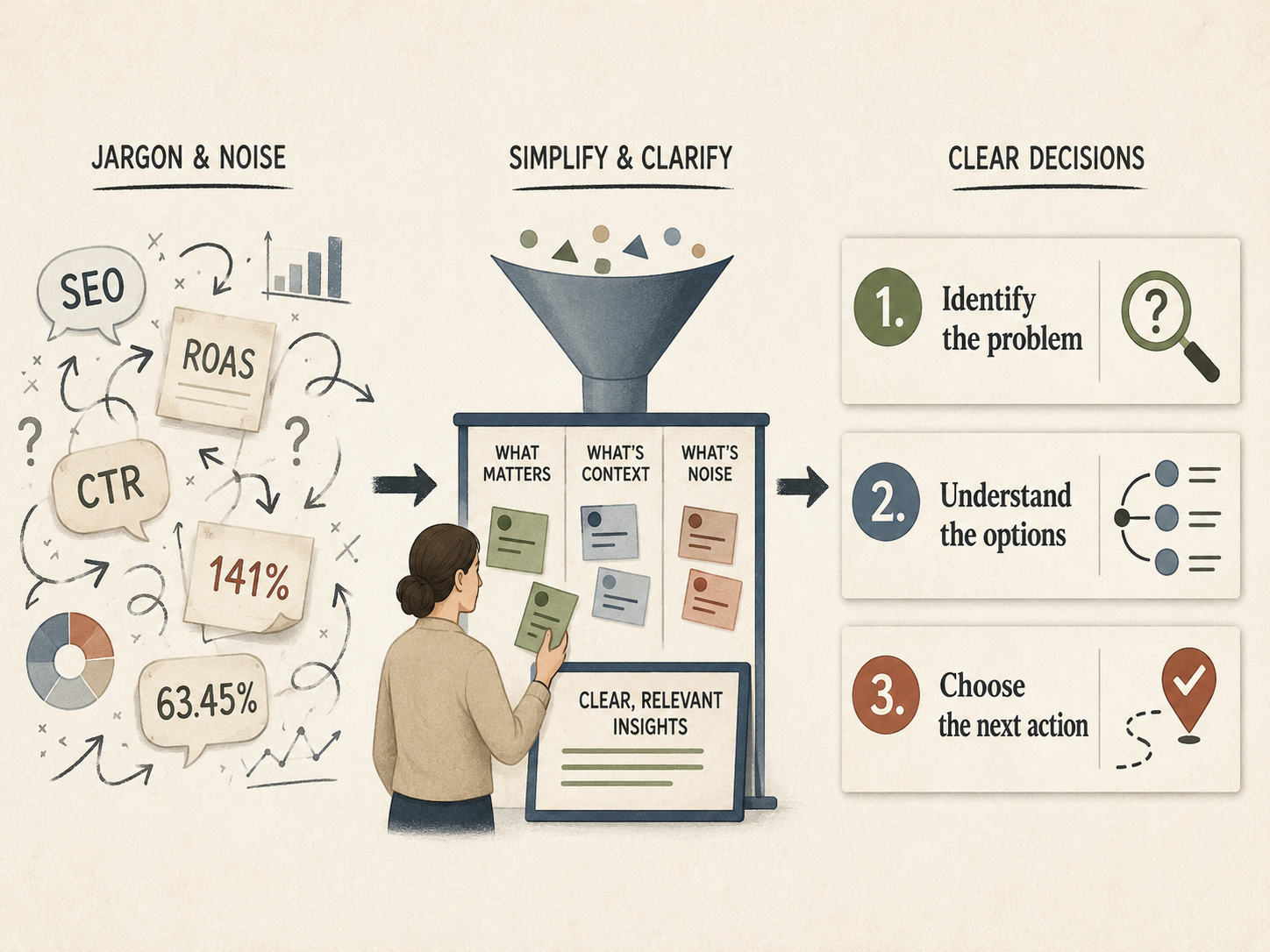
Yet digital services are often presented through abbreviations, inflated terminology and promises that sound precise without being useful:
Improve your SEO by 141%.
Increase your ROAS by 63.45%.
Install this app now and boost conversions instantly.
The numbers look scientific. The language sounds specialised. The urgency suggests that waiting one more day could damage the business.
But the owner is often left with the same practical questions:
- What is actually wrong?
- Why does it matter?
- What should be changed?
- What do I need to decide?
- What will happen after I pay?
At Vayluna, clear language is not a finishing touch added after the real work. It should be part of the service itself.
That principle applies to our articles, audits, recommendations, outreach and the wider range of Vayluna services: explain the problem in ordinary language, show the practical options and make the next decision understandable.
Stop making clients learn agency language
Specialists naturally develop shorthand.
Developers talk about frameworks, APIs, rendering, deployments and technical debt. Marketers talk about CTR, ROAS, attribution, funnels and conversion rates. Search specialists talk about canonical tags, indexing, schema and domain authority.
Those terms can be useful between people doing the work.
They become a problem when the client is expected to learn them before receiving a straight answer.
A restaurant owner does not need to hear:
Your mobile UX is creating conversion friction and depressing the CTR from your local-intent landing pages.
They need to hear:
People searching on their phones are reaching the page, but the menu is difficult to open and the reservation button is easy to miss. That may be costing you bookings.
The technical diagnosis can still exist underneath.
The explanation should help the owner understand the consequence.
Expertise should reduce complexity for the client, not transfer it to them.
Jargon can hide more than it explains
Complicated language is not always dishonest.
Sometimes a specialist is simply used to speaking with other specialists. Sometimes a precise technical term is genuinely the clearest term available.
But jargon can also hide three uncomfortable things.
The speaker may not understand the issue well enough to explain it simply
Repeating specialist vocabulary is easier than translating a diagnosis into a practical decision.
A person can say “conversion optimisation” without identifying where customers actually stop.
They can say “technical SEO” without explaining which pages cannot be found or understood by search engines.
They can say “improve engagement” without deciding what useful action a visitor should take.
Clear explanation requires more understanding, not less.
The service may be less special than the language suggests
A recommendation can sound advanced while describing basic work:
- make the contact button easier to find;
- correct an outdated address;
- compress a very large image;
- complete a missing translation;
- repair a form;
- rewrite an unclear introduction.
That work may still be valuable.
It does not need to be disguised as a transformation programme.
The client’s uncertainty may be part of the sales method
When people do not understand the diagnosis, they may assume the specialist must be right.
That creates an unhealthy imbalance. The client is pushed to approve a solution without being able to judge whether it is proportionate.
Good advice should leave the owner more capable of deciding, not more dependent on the person presenting it.
Fake precision is still fake
One of the strangest habits in digital marketing is the use of extremely precise numbers for outcomes that cannot be predicted with that precision.
An advertisement promises 63.45% more return.
A tool claims that one installation will improve search performance by 141%.
A consultant predicts a specific increase in conversions before reviewing the traffic, offer, market, website or measurement setup.
The decimals make the promise look calculated.
They do not make it credible.
Before accepting a percentage, basic questions still need answers:
- Better according to which measurement?
- Compared with what starting point?
- Over which period?
- Was the result measured across similar businesses?
- Were advertising, product, labour and fulfilment costs included?
- Did the tool cause the result, or did several changes happen together?
- Is the percentage an average, a best case or simply a promotional claim?
A number without context is another form of jargon.
It gives the appearance of certainty while removing the information needed to assess it.
Vayluna should not promise an exact result when the evidence does not support one. A useful recommendation can explain what is likely to improve, what remains uncertain and how the result should be measured after the change.
Urgency should come from the problem, not the advertisement
False urgency is closely related.
The familiar message is:
Act now before your competitors leave you behind.
Or:
There are only three places left.
Or:
Install today to avoid losing more revenue.
Sometimes a problem really is urgent. A broken checkout, an exposed security issue or a contact form that loses every enquiry should not wait.
But the urgency should come from evidence.
If a restaurant menu is difficult to read on mobile, the practical question is how much relevant traffic reaches that page and how strongly the problem affects decisions. If a translated page is incomplete, the priority depends partly on how much of the real audience needs that language.
Not every imperfection is an emergency.
A business owner should be told why something matters and what happens if it is not fixed—not pushed into a purchase through manufactured panic.
Start with the decision the owner needs to make
A useful conversation should work from the business decision backwards.
Instead of beginning with a service label, begin with the owner’s question.
“I want more people to find my business.”
Then examine whether the website can be found for relevant searches, whether the business information is complete and whether the pages clearly describe the offer.
The technical work may include SEO.
The owner’s objective is visibility.
“People visit the site, but too few contact us.”
Then inspect the offer, trust signals, mobile experience, forms, calls to action and points of hesitation.
The technical discussion may include conversion rate optimisation.
The owner’s objective is more useful enquiries.
“Customers keep asking questions that are already on the site.”
Then the problem may be navigation, wording, hierarchy or inconsistent information.
The solution may be content and structure, not a completely new website.
“I do not know whether my website needs a repair or a rebuild.”
Then the first useful service is diagnosis.
Vayluna’s services include a visitor-view website quality audit intended to make that decision clearer without assuming in advance that the largest project is the correct answer.
The language can remain simple because the decision is practical:
What works?
What creates friction?
What should be addressed first?
A small glossary without the theatre
Technical terms will still appear. Hiding them completely would be artificial.
The better rule is simple: use the term when it helps, and explain it in ordinary language when it matters.
SEO
Search Engine Optimisation
Work that helps search engines find, understand and present relevant website pages to people searching for related information.
It is not a guarantee of first place in Google.
CTR
Click-Through Rate
The percentage of people who see a link, advertisement or result and then click it.
A low percentage does not explain why people did not click.
Conversion rate
The percentage of visitors who complete the action the business wants, such as buying, booking or sending an enquiry.
The useful action must be defined before the number means anything.
ROAS
Return on Ad Spend
The amount of revenue attributed to advertising compared with the amount spent on those advertisements.
A ROAS of 2 means £2 in attributed revenue for every £1 spent on advertising.
Revenue is not profit. Product costs, payment fees, delivery, returns and operating expenses still matter.
CTA
Call to Action
The button or instruction that tells a visitor what they can do next.
Examples include reserving a table, requesting a quote or viewing a menu.
CMS
Content Management System
The system used to create, edit and manage website content.
Responsive
A website layout that adapts to different screen sizes and remains usable on phones, tablets and desktop devices.
Technical SEO
Technical work that helps search engines access, interpret and organise website pages correctly.
The phrase should still be followed by the actual issue: a blocked page, broken redirect, duplicate version or missing information.
Conversion friction
Anything that makes it unnecessarily harder for a visitor to take the intended next step.
That could be a long form, unclear button, missing price, unreadable menu or conflicting information.
Clear language does not mean simplistic work
There is a risk that “plain language” becomes another excuse for shallow advice.
That is not the standard.
A specialist may still need to inspect analytics, code, page structures, advertising data, search behaviour and technical integrations. The work behind the explanation can be complex.
The client-facing conclusion should be clear because the analysis was done properly.
A doctor does not need to hide medical knowledge in order to explain a diagnosis to a patient. The explanation becomes useful when the specialist translates expertise into understandable choices.
Digital services should meet the same standard.
The client does not need every internal detail.
They do need enough information to judge the recommendation.
What this means for Vayluna
This principle should apply across everything Vayluna builds.
In articles
Use specialist terms only when they add precision. Explain them. Do not write as though every reader works in marketing, development or ecommerce.
In audits
Describe the visible issue, its likely consequence and the proportionate next step.
Do not hide a predetermined sales pitch behind a score.
In outreach
Do not tell a business that its “digital presence is underperforming”.
Show the specific issue:
The English menu link opens the French version.
The reservation button for this location leads to another branch.
The contact page is difficult to use on a phone.
In proposals
State what will be done, what is not included, what the client must provide and what outcome can reasonably be expected.
Do not use complexity to justify the fee.
In results
Separate what was measured from what was inferred.
Do not turn an improvement into a guarantee for the next project.
The wider Vayluna service offering will continue to expand, but the communication standard should remain the same: useful expertise, translated into clear decisions.
Clear language is part of the service
A client should not leave a conversation impressed by how many specialist terms were used.
They should leave understanding:
- what is happening;
- why it matters;
- what the realistic options are;
- what they need to decide next.
Clear language is not a simplified version of the service.
It is part of the service.
No invented certainty.
No acronyms used as decoration.
No complexity added merely to justify a fee.
Explain the problem.
Explain the options.
Then do the work.